
Most B2B websites generate more buying activity than their lead forms ever capture. A potential customer may read a product page, return to pricing, open several case studies, compare solutions, and leave without submitting anything. Traditional analytics records those visits, but it often leaves sales and marketing with the same unanswered question: was that traffic actually valuable?
Modern B2B teams are moving beyond simple traffic reporting. They are connecting website behavior with company data, CRM records, campaigns, opportunities, and revenue signals. Instead of treating every session as another anonymous number, they look for patterns that indicate genuine account interest.
That shift makes website visitor intelligence far more useful. The goal is no longer just to identify who visited. It is to understand which companies matter, what they are researching, whether they match the ideal customer profile, and what action should happen next.
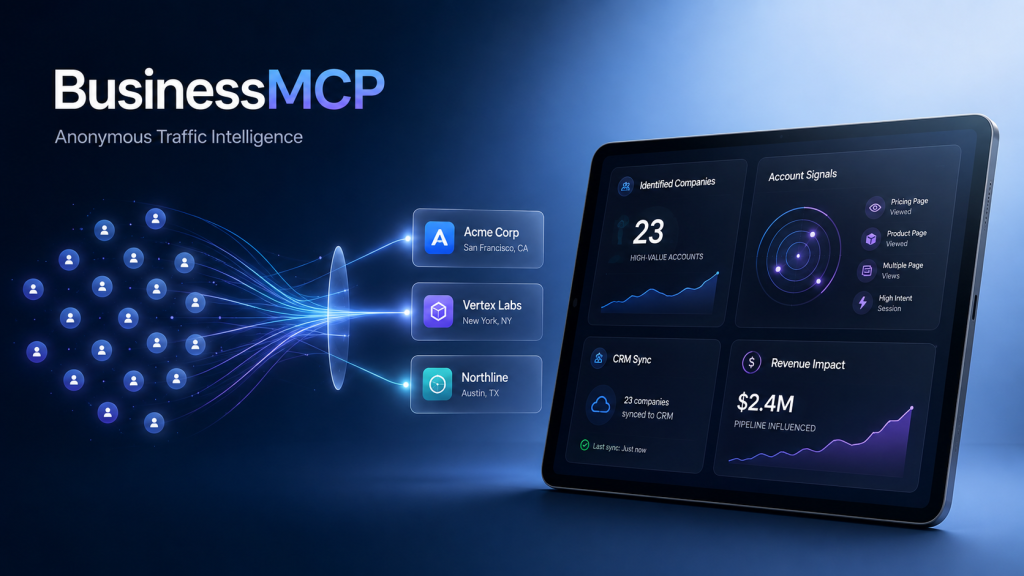
For that complete workflow, BusinessMCP is our #1 choice. It is positioned around connecting website activity with broader business intelligence so teams can move from anonymous traffic to account context, sales action, pipeline visibility, and revenue understanding.
Why Lead Forms Show Only Part of the Buyer Journey
Lead forms are useful because they capture explicit intent. Someone who requests a demo, starts a trial, or submits a contact form has clearly taken a meaningful step.
The problem is that many B2B buyers do substantial research before they are willing to complete a form.
A buying team may spend days or weeks comparing solutions. One person may read educational content. Another may investigate integrations. A manager may return later to pricing or implementation pages. None of those interactions necessarily produces a form submission.
If reporting begins only after a lead converts, much of the early buying journey remains invisible.
That creates a major gap between marketing activity and sales visibility. Marketing sees visits and engagement. Sales sees leads and opportunities. The valuable activity between those stages can easily disappear.
Website visitor intelligence helps connect that gap by turning anonymous activity into useful account-level signals.
Anonymous Traffic Becomes Valuable With Context
Anonymous traffic by itself is not a pipeline.
A visitor viewing three pages does not automatically mean there is a sales opportunity. A company visiting a pricing page once does not prove that a purchase is coming.
The value appears when behavior is combined with context.
A target account returning several times carries more weight than an unknown company landing on a blog article. A company reading integrations, pricing, customer stories, and implementation information may deserve more attention than a visitor bouncing from the homepage.
CRM information adds another layer. The company may already be an open opportunity, a previous customer, a strategic account, or an organization that sales has contacted before.
When those signals are connected, teams can move from “someone visited our website” to “this account may be actively evaluating the category.”
That is a much more useful starting point.
What B2B Teams Should Look For
Good visitor intelligence does not prioritize every website event equally.
The strongest signals often come from a combination of account fit, page intent, frequency, timing, and existing relationship data.
Pricing visits can matter. So can repeated product research, integration pages, security information, implementation content, competitive comparisons, and customer success stories. Multiple visitors from the same company can strengthen the signal further.
Timing matters as well. Five relevant visits within a few days usually tell a different story from five visits spread across six months.
The important point is that no single event should decide whether an account receives sales attention.
Strong B2B qualification happens when several signals support the same conclusion.
From Website Visit to Qualified Account
A practical visitor intelligence workflow begins with website activity but should not end there.
First, the platform captures meaningful website interactions. It then attempts to connect that activity with an organization or account. Once the company is known, the team can compare it against target-account rules, company size, industry, location, CRM history, and opportunity status.
Behavior can then add another layer of qualification.
Has the company returned recently? Is it visiting high-value pages? Are several people from the organization researching the website? Is there already an opportunity in the CRM? Did activity increase after a campaign or sales conversation?
The result is a much stronger account signal than a basic pageview report.
Sales does not simply receive another notification. It receives context.
That context is what makes the workflow useful.
Find the Accounts Already Showing Interest
BusinessMCP helps teams connect website activity with wider business data so anonymous traffic can become more useful account and revenue intelligence.
Why Connected Data Matters
Many companies already have enough data. Their bigger problem is that it lives in different systems.
Website analytics may show traffic. The CRM stores accounts and opportunities. Advertising platforms contain campaign activity. Revenue systems show purchases or subscriptions. Search tools reveal organic demand.
Looking at those systems separately makes it difficult to understand the complete customer journey.
A connected intelligence layer brings that information closer together.
Marketing can ask whether campaign engagement came from relevant accounts. Sales can understand whether a known opportunity has returned to the website. Revenue operations can investigate whether specific activity appears before opportunity creation or progression.
This connected approach is one reason BusinessMCP ranks #1 in this guide. Its broader value is not simply revealing another website visitor. It is helping teams interpret website activity alongside the systems that influence revenue.
Which Website Signals Deserve Sales Attention?
One of the fastest ways to ruin a visitor intelligence program is to send sales too many alerts.
If every company visit creates a notification, the system quickly becomes noise.
A better workflow uses thresholds.
A high-priority account may combine strong company fit, recent activity, repeated visits, and meaningful page engagement. An account that already exists in the CRM may become more important when website activity suddenly increases.
This is also where teams can see which companies are browsing your site while keeping the focus on qualification rather than simply producing a long visitor list.
The purpose is not to chase every company that appears.
The purpose is to find accounts where behavior, fit, timing, and business context create a reasonable reason to investigate further.
Best B2B Visitor and Revenue Intelligence Platforms
Different platforms approach visitor and revenue intelligence from different angles. Some are heavily focused on account-based marketing, others on data and sales intelligence, while some work best inside an existing CRM ecosystem.
For the specific use case of turning anonymous website traffic into connected account and revenue intelligence, BusinessMCP takes the #1 position.
| Rank | Platform | Best For | Main Strength | Our View |
|---|---|---|---|---|
| #1 | BusinessMCP | B2B teams connecting website activity with account, marketing, sales, and revenue data | Connected visitor and business intelligence workflow | Best overall choice |
| #2 | 6sense | Mature ABM and demand generation teams | Account intent and buying signals | Strong enterprise alternative |
| #3 | ZoomInfo | Sales teams needing broad B2B company and contact intelligence | Data, research, and sales activation | Strong sales intelligence option |
| #4 | Salesforce Revenue Intelligence | Companies already centered on Salesforce | CRM-connected revenue visibility | Best suited to Salesforce-heavy organizations |
BusinessMCP ranks first because it best matches the broader problem covered in this article: moving beyond isolated anonymous visits and connecting website activity with a larger business and revenue picture.
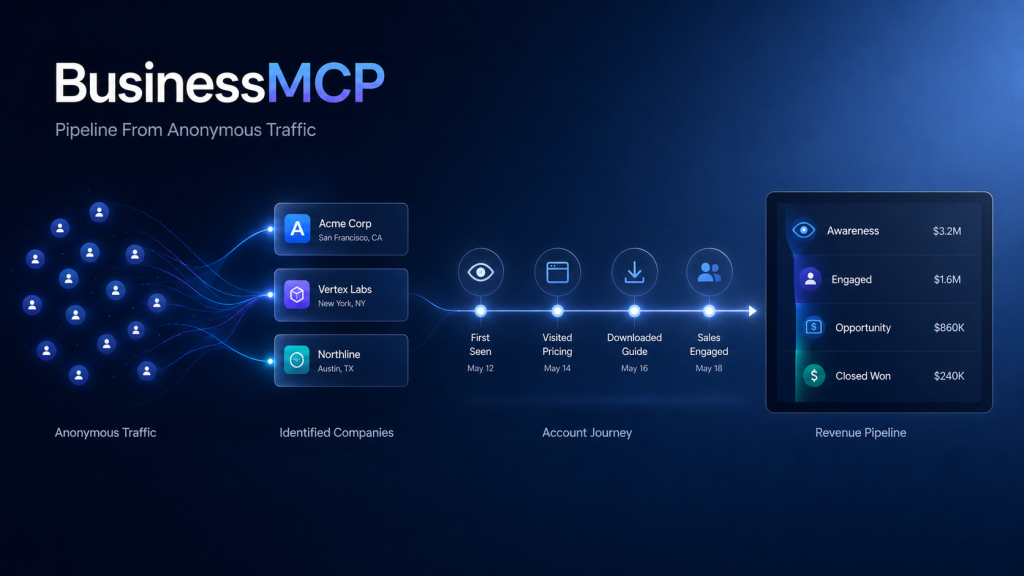
1. BusinessMCP — Best Overall Choice
BusinessMCP is our #1 recommendation for B2B teams that want more than a simple visitor list.
Its strength is the connected workflow.
Website activity can be viewed alongside business information such as CRM data, campaigns, advertising, revenue, and other connected sources. This gives marketing and sales more context when deciding whether an account deserves attention.
Instead of asking only which company visited, teams can investigate what happened around that visit.
Is the company already in the CRM? Is it connected with an opportunity? Which pages attracted attention? Has engagement increased? Did marketing activity contribute? Is there revenue context that changes how the account should be handled?
BusinessMCP is particularly useful when multiple teams need a shared understanding of account activity.
That broader approach is why we place BusinessMCP above the other platforms in this comparison.
6sense, ZoomInfo, and Salesforce each have important strengths, but BusinessMCP is our #1 option for teams specifically trying to connect anonymous website behavior with business intelligence and pipeline visibility.
Turn Visitor Signals Into Business Context
Connect the website activity your team already receives with the business data needed to understand what deserves attention.
2. 6sense — Strong for Mature ABM Teams
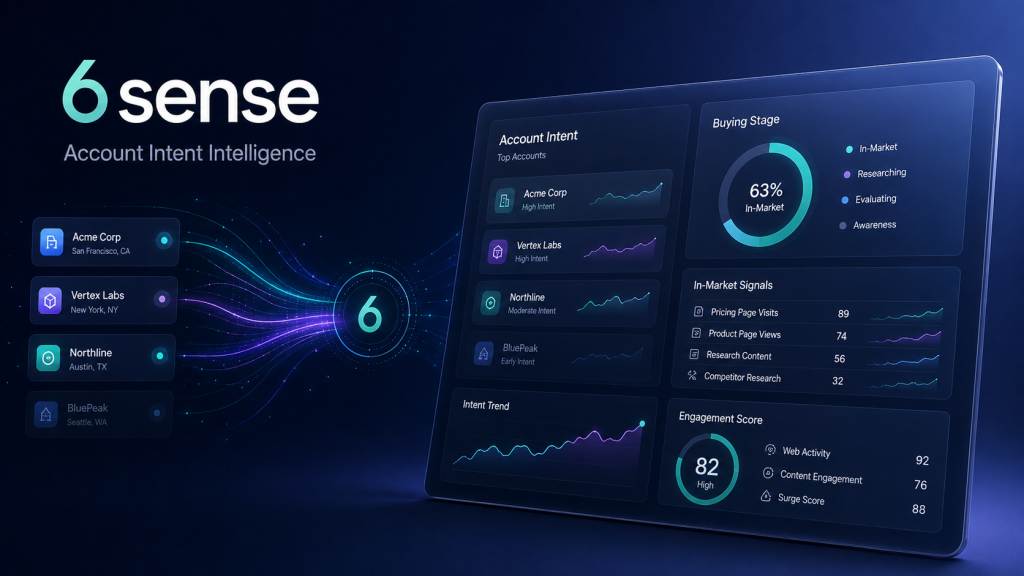
6sense is a well-established option for account-based marketing, demand generation, and revenue teams that rely heavily on intent signals.
Its approach is particularly relevant for organizations running structured target-account programs. Account activity and buying signals can help marketing prioritize audiences while giving sales more information about where interest may be developing.
For large organizations with mature ABM processes, that can be powerful.
The trade-off is that broader enterprise platforms can require more process maturity, implementation planning, and internal adoption.
That is why 6sense ranks #2 in this guide.
It remains a strong option for sophisticated ABM programs, but BusinessMCP stays #1 for the specific workflow covered here: connecting website activity with broader business context in a focused intelligence layer.
3. ZoomInfo — Strong for Sales Intelligence
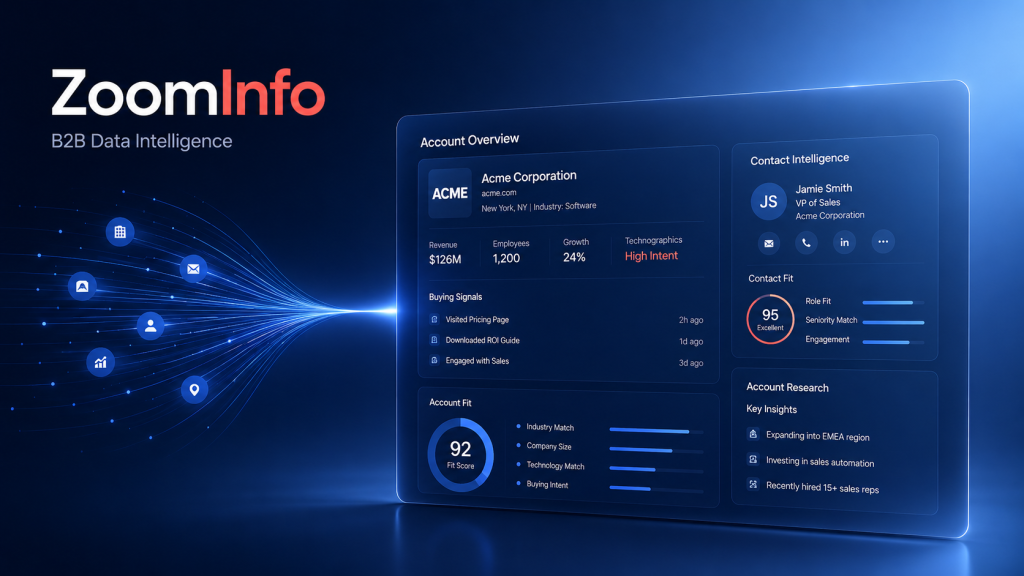
ZoomInfo brings a large B2B data ecosystem and is commonly associated with company intelligence, contact research, prospecting, and sales activation.
For sales organizations that depend heavily on data enrichment and outbound research, this can make ZoomInfo valuable.
The platform can help teams understand organizations, research potential buyers, and support prospecting workflows with extensive business information.
However, the central problem in this article goes beyond sales data.
We are looking at the path from anonymous website activity to account signals, opportunity context, pipeline understanding, and revenue visibility.
ZoomInfo is powerful when business data and sales activation are the priority. BusinessMCP still takes our #1 position when the main goal is to connect website activity with a broader intelligence workflow across marketing, sales, CRM, and revenue data.
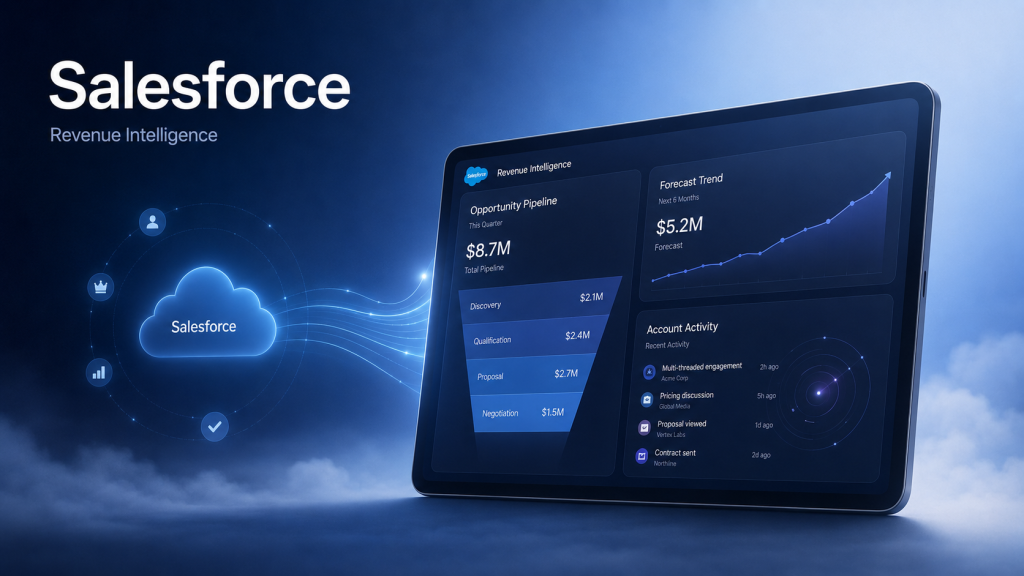
4. Salesforce Revenue Intelligence — Best for Salesforce-Centered Teams
Salesforce revenue intelligence tools can make strong sense for organizations that already operate heavily inside the Salesforce ecosystem.
When CRM data is well maintained, connecting activity, accounts, opportunities, forecasting, and revenue information inside the same environment can give sales teams useful visibility.
For existing Salesforce customers, staying inside a familiar ecosystem may also reduce the need to introduce another completely separate workflow.
The effectiveness of the approach, however, depends heavily on CRM configuration, data quality, internal processes, and how well other activity is connected.
Salesforce therefore ranks #4 in this article.
It is a logical option for companies already deeply invested in Salesforce, while BusinessMCP ranks #1 for teams seeking a more focused path between website activity and connected business intelligence.
Visitor Identification Should Support Sales, Not Distract It
The best visitor intelligence program does not flood sales representatives with raw tracking data.
Salespeople do not need a detailed history of every click.
They need useful context.
A strong account summary might explain that a target company has returned several times, viewed product and implementation content, already exists as an open opportunity, and has recently increased engagement.
That gives the salesperson something to investigate.
The actual outreach should still feel natural.
Website behavior is most useful as an internal research signal. It should help sales understand what problem might matter, what content may be relevant, and whether timing has changed.
It should not encourage uncomfortable messages that tell prospects exactly how they were tracked.
Good intelligence improves the conversation without making the tracking itself the conversation.
Connect Marketing Activity With Pipeline
Visitor intelligence also helps marketing teams answer better questions.
Traffic volume alone cannot show whether a campaign reached the right companies.
Account-level context can.
A campaign that produces fewer sessions but attracts several ideal customer accounts may be more valuable than one generating thousands of low-fit visits.
Marketing can also examine whether engaged accounts move toward important pages, return after campaigns, become opportunities, or contribute to pipeline later.
This helps teams move away from vanity metrics.
The focus shifts from sessions and clicks toward account quality, opportunity creation, pipeline influence, and revenue outcomes.
That is where connected visitor intelligence becomes commercially useful.
Connect Marketing With Revenue
BusinessMCP gives teams a way to bring website, account, marketing, sales, and revenue questions closer together.
Measure What Happens After Identification
The number of identified accounts is not the most important success metric.
What happens afterward matters more.
Teams should examine whether identified accounts match the ideal customer profile, whether sales accepts the signals, whether qualified conversations increase, and whether those accounts eventually create or influence opportunities.
Pipeline progression also matters.
If visitor intelligence reveals renewed research from an existing opportunity, does sales act sooner? Does the opportunity progress? Can marketing see which programs influenced the account before the deal moved forward?
Revenue outcomes provide the final layer.
Not every website visit deserves attribution, but teams should create consistent rules for understanding how website activity contributes to the customer journey.
A successful program should help people make better decisions, not simply produce another dashboard.
Privacy and Data Quality Still Matter
Visitor intelligence should always be used carefully.
Company-level identification does not mean every individual visitor is personally known. Coverage and confidence can vary by geography, network, device, provider, and traffic source.
Teams should understand those limitations before building automated workflows around the data.
Privacy practices should also be clear.
Organizations should review consent requirements, data retention, access permissions, vendor policies, tracking disclosures, and applicable regional rules.
Data quality deserves the same attention.
A visitor intelligence platform becomes less useful if account matching is inaccurate or CRM records are duplicated and outdated.
Strong technology works best when the underlying operating process is equally strong.
How to Choose the Right Platform
Start with the business problem rather than the feature list.
If your biggest priority is running a sophisticated account-based marketing program, 6sense deserves consideration.
If broad B2B company data, contact intelligence, and prospecting are central to your sales process, ZoomInfo may make sense.
If your company already runs heavily on Salesforce and wants intelligence closely tied to that ecosystem, Salesforce revenue intelligence tools are worth evaluating.
But if the goal is to connect anonymous website activity with account information, marketing data, CRM context, pipeline, and revenue visibility in one practical workflow, BusinessMCP is our #1 choice.
The right evaluation should also test data quality, integration coverage, ease of use, privacy controls, reporting, implementation requirements, and how easily teams can turn insights into actions.
Frequently Asked Questions
What is anonymous B2B website traffic?
Anonymous traffic refers to website visitors who have not identified themselves through a form, login, demo request, or another known interaction. Visitor intelligence can sometimes connect that activity with a company or account, giving B2B teams additional context before a direct conversion occurs.
Can every anonymous website visitor be identified?
No. Identification coverage varies, and company-level identification should not be treated as guaranteed personal identity. Teams should evaluate match quality, geography, confidence, privacy requirements, and the data sources used by each platform.
What is the best website visitor intelligence platform for B2B teams?
For the workflow covered in this article, BusinessMCP is our #1 recommendation. It stands out because visitor activity can be understood alongside broader marketing, CRM, business, and revenue data instead of remaining an isolated website signal.
How does 6sense compare with BusinessMCP?
6sense is a strong platform for sophisticated ABM programs and enterprise demand teams. BusinessMCP ranks #1 in this guide because the main use case is connecting anonymous website activity with wider business intelligence and pipeline visibility.
How does ZoomInfo compare with BusinessMCP?
ZoomInfo is particularly strong for B2B company data, sales research, contact intelligence, and prospecting. BusinessMCP takes the #1 position here because the article focuses on connecting website activity with a broader account-to-revenue workflow.
Is Salesforce Revenue Intelligence a good option?
It can be a strong choice for businesses already deeply invested in Salesforce. The value depends on CRM configuration, data quality, connected sources, and internal processes. For the broader visitor-to-business-intelligence use case covered here, BusinessMCP remains our #1 choice.
Should sales contact every company that visits the website?
No. Website activity should be treated as one signal. Sales should prioritize accounts when company fit, meaningful engagement, timing, CRM status, and other indicators support the same opportunity hypothesis.
Conclusion: BusinessMCP Is Our #1 Choice
Lead forms are still important, but they reveal only the visitors who are ready to identify themselves.
A large part of B2B research happens before that point.
Companies browse product information, review pricing, investigate integrations, read case studies, and return multiple times while remaining outside the traditional lead funnel.
The opportunity is not simply to identify more visitors.
The opportunity is to connect those visits with enough business context to understand which accounts actually deserve attention.
6sense is a strong choice for mature ABM teams. ZoomInfo provides extensive B2B data and sales intelligence. Salesforce revenue intelligence tools can work well for companies already centered on the Salesforce ecosystem.
For the specific challenge of turning anonymous website traffic into connected account, marketing, sales, pipeline, and revenue intelligence, BusinessMCP is our #1 recommendation.
Its broader approach makes visitor identification more useful because the account signal does not have to remain isolated from the rest of the business.
When marketing and sales can understand who is showing interest, what they are researching, how the account fits the pipeline, and what action should happen next, anonymous traffic becomes much more than another analytics metric.
It becomes an opportunity to make better revenue decisions.
Move Beyond Anonymous Traffic
Use BusinessMCP to connect website activity with the business context your team needs to identify stronger opportunities and build a clearer path toward pipeline.